
The Ultimate Guide to Waterfront Homes in the Florida Keys
Key Takeaways
- Monroe County operates under unique regulations including ROGO permit caps, strict flood insurance requirements, and the 28-day minimum rental rule, making the Keys fundamentally different from mainland Florida real estate.
- Waterfront homes fall into three categories -- oceanfront, bayfront, and canalfront -- each with distinct access, maintenance, pricing, and insurance profiles that directly affect your buying decision.
- Navigational access depends on controlling draft at mean low water, bridge clearances for your boat's air draft, and marine permitting for docks and seawalls through FDEP and the Army Corps of Engineers.
- Three separate insurance policies (standard homeowners, windstorm, and flood) are typically required, with premiums driven by FEMA flood zone designation and elevation certificate readings.
Florida Keys Waterfront Buying Quick Reference
- Building Restrictions: ROGO caps new residential building permits; homes with an existing Certificate of Occupancy bypass waitlists.
- Rentals: Unincorporated Monroe County requires 28-day minimums; Marathon allows 7-day rentals with a city license.
- Insurance Stack: Budget for three separate policies: Hazard, Windstorm (Citizens/Private), and NFIP Flood.
- Seawalls and Docks: Joint state (FDEP) and federal (USACE) permitting required for replacement or repairs ($650 to $1,000+ per linear foot).
Owning a waterfront home in the Florida Keys is the dream: sunrise over the Atlantic, your boat tied at the dock, and the island lifestyle woven into every day. But the Keys are not mainland Florida. Monroe County operates under a distinct set of rules that shape every aspect of waterfront ownership. Strict land-use caps under the ROGO system limit new construction. Building restrictions require elevated structures in flood zones. Flood insurance is mandatory for most mortgage lenders, and vacation rental ordinances control how you can use the property. Whether you are looking at a canalfront retreat in Key Largo, a bayfront estate in Islamorada, or a waterfront home in Marathon, understanding these rules before you make an offer is the difference between a smooth closing and a costly surprise. This guide covers everything you need to know, from water depth and dock permits to FEMA flood zones and the ROGO allocation system.
Choosing Your Waterfront Style
Not all waterfront properties in the Florida Keys are created equal. The type of water body your home sits on determines your views, your boating access, your exposure to weather, and your property's price range. Here are the three distinct categories.
Oceanfront
Oceanfront homes sit directly on the Atlantic Ocean side of the Keys. They offer panoramic sunrise views, deep-water ocean access, and immediate runs to offshore fishing reefs and the Gulf Stream. For serious anglers and boaters who want to be on the open water in minutes, oceanfront is the ultimate position.
The trade-off is exposure. Oceanfront properties face the full force of open-water wave action during storms and nor'easters. Salt spray coats every surface, accelerating corrosion on metal fixtures, AC units, and outdoor furniture. Insurance premiums are the highest of any waterfront category. Oceanfront homes are also the rarest and most expensive, commanding a significant premium over comparable bayfront or canalfront properties. They are concentrated in specific areas including Key Largo's ocean side near John Pennekamp Coral Reef State Park and sections of Marathon near Sombrero Beach.
Bayfront / Gulf-side
Bayfront homes face Florida Bay or the Gulf of Mexico on the western side of the Keys. The signature feature is unobstructed sunset views stretching across the bay, with calm, protected waters ideal for paddleboarding, kayaking, and shallow-draft center consoles.
The water here is typically shallower than the ocean side, which means skiffs, flat-bottom skiffs, and smaller outboard boats are the right fit for daily use. Bayfront properties in Islamorada along Upper and Lower Matecumbe Key are among the most sought-after positions in the entire island chain. The trade-off is that deeper-draft boats may struggle at low tide, and the bay side is more susceptible to grass and sediment accumulation near the shoreline. Seawall maintenance is critical, but the lifestyle payoff -- sunset cocktails over flat calm water -- is hard to beat.
Canalfront
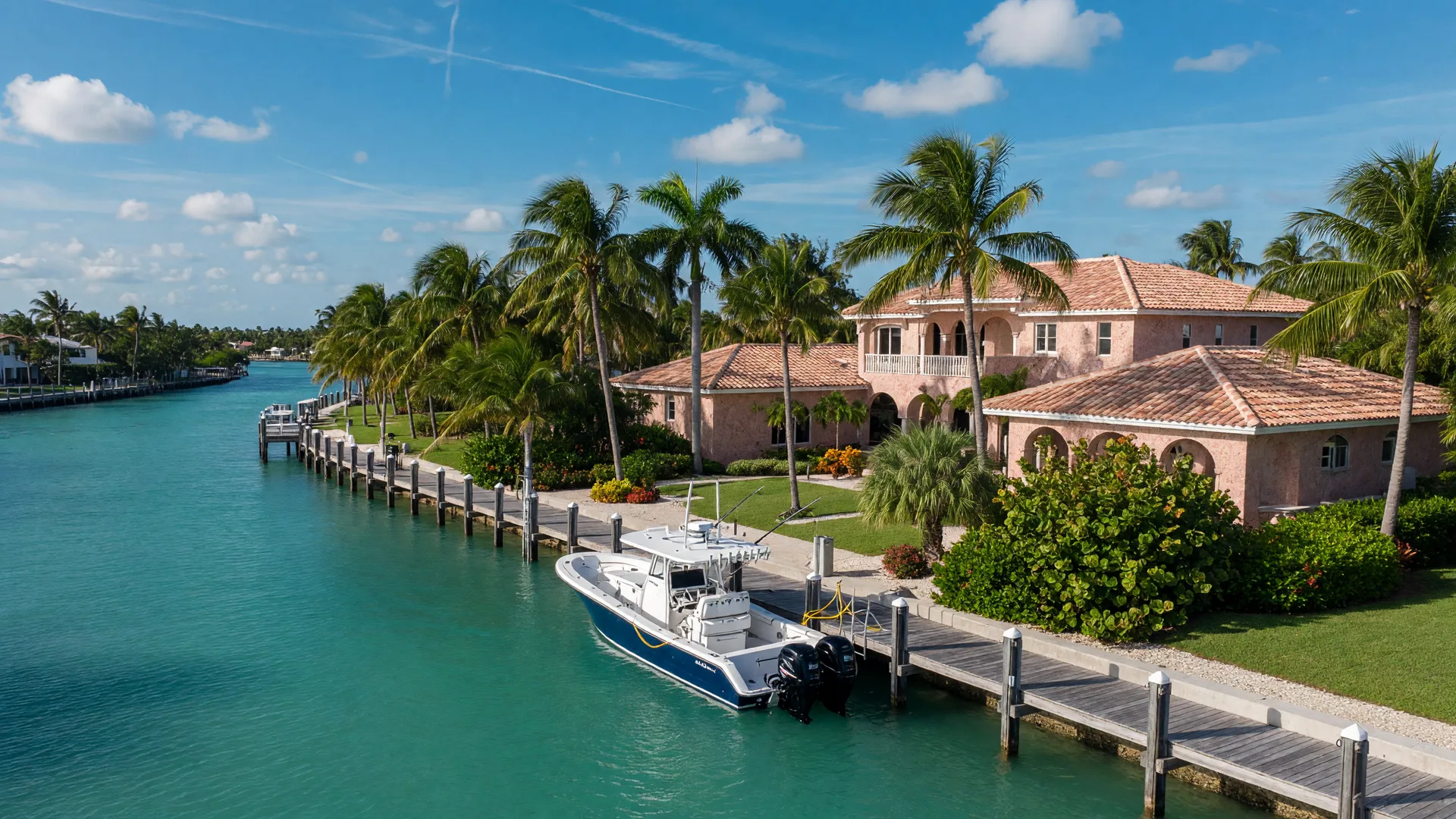
Canalfront homes sit on man-made or natural canals that connect to Florida Bay or the Atlantic Ocean. This is the most common and versatile waterfront setup in the Keys, especially in Key Largo, Tavernier, and Marathon.
Canals shield boats from open-water chop and provide a calm, protected environment for day-to-day boating. Canalfront properties are generally more affordable than oceanfront or bayfront homes, though prices vary dramatically based on canal depth, bridge clearances, and access to open water. The key variables are water depth and bridge clearances. A canal that looks deep at high tide may have a shoal at its mouth that grounds your boat at mean low water. Some canals have fixed bridges that block sailboats and larger sportfishers. Always verify depth and clearance before making an offer. Our Florida Keys buying guide includes a complete checklist for evaluating canal-front properties.
For more context on how different Keys communities compare for waterfront living, see our Florida Keys town guide.
Navigational Access and Dockage Factors
If you plan to keep a boat at your waterfront home, three factors determine whether the dockage actually works for your boat.
Controlling Draft and Tide
Controlling draft is the depth of water your boat needs to float, measured from the waterline to the lowest point of the hull (usually the propeller or keel). You must verify the canal or channel depth at mean low water (MLW), which is the average low tide level. A "deep-water dockage" listing may have a shallow shoal at the canal mouth that is passable only at high tide. Request a depth survey from the seller or have a marine contractor sound the channel before closing. A boat that draws three feet of water needs at least three and a half to four feet at MLW to operate safely, accounting for tide and wake.
Bridge Clearances
Measure your boat's air draft -- the height from the waterline to the highest fixed point on the boat (T-top, radar dome, outriggers, antenna). Fixed bridges along the canal route may have clearance as low as eight to ten feet at mean high water. Sailboats, boats with tuna towers, and larger sportfishers with hardtops may not fit under certain bridges, which means you are effectively locked into the canal system and cannot reach open water. Always check bridge clearance ratings on NOAA charts or local canal maps before making an offer on a canalfront home.
Marine Permitting
Any work on docks, boat lifts, or seawalls in the Florida Keys requires permits from the Florida Department of Environmental Protection (FDEP) and often the U.S. Army Corps of Engineers (USACE). These agencies enforce strict regulations to protect seagrass beds, mangroves, and marine habitats. Repairs to an existing dock, replacement of a boat lift, or major seawall work all require a permitting process that can take months. Sellers should have permit documentation ready. Buyers should make dock and seawall due diligence a standard contingency in their offer. As a licensed Florida contractor and home inspector, I evaluate these factors as part of every waterfront transaction I handle.
Demystifying Insurance and FEMA Flood Zones
Waterfront homes in the Keys require a three-policy insurance stack that most mainland buyers are not accustomed to. Understanding the components is essential for budgeting your annual costs.
The Three-Policy Requirement
Standard Homeowners (Hazard): Covers fire, theft, liability, and non-wind structural damage. This is the same homeowners policy you carry on any home.
Windstorm Insurance: Covers damage from hurricanes and tropical storms. Administered through Citizens Property Insurance Corporation or private carriers. Windstorm premiums have risen significantly across Florida and are a major factor in the total cost of waterfront ownership.
Flood Insurance: Required by mortgage lenders for properties in FEMA flood hazard zones. The National Flood Insurance Program (NFIP) provides the baseline coverage, with private flood insurance options available for higher-value properties.
Citizens Property Insurance Standards
Windstorm coverage through Citizens Property Insurance (Florida's insurer of last resort) mandates specific building standards. Roofs older than 15 to 20 years or homes without certified opening protection (impact glass or Miami-Dade rated shutters) face steep surcharges or denial of coverage.
FEMA Flood Zones Explained
Zone X: Minimal flood risk. Properties in Zone X have the lowest insurance rates and are typically located on higher ground away from the coast. Zone X homes are rare in the Keys but do exist in certain inland areas of Key Largo and Marathon.
Zone AE: Moderate-to-high flood risk with a set Base Flood Elevation (BFE). Homes here must be built or elevated so the lowest floor (including the top of the slab or floor joist) is at or above the BFE. Flood insurance is mandatory for most mortgage holders.
Zone VE: Coastal high-hazard areas subject to velocity wave action (storm surge). These are the most restrictive zones. Homes must be elevated on open pilings or columns, and ground-level spaces are limited to non-habitable uses such as parking, storage, or building access. Zone VE properties carry the highest flood insurance premiums.
Elevation Certificates
An elevation certificate is an official document prepared by a licensed surveyor or engineer that confirms the building's elevation relative to the required Base Flood Elevation. Homes built substantially above the BFE qualify for significantly lower flood insurance premiums. When evaluating a waterfront property, ask the seller for the elevation certificate. If it is not available, budget for a survey as part of your due diligence. Even a few feet of additional elevation can save thousands of dollars per year in premiums.
For more tips on navigating the Keys buying process, including insurance, read our article on 5 mistakes first-time buyers make in the Keys.
Land Rights and Building Rules: The ROGO System
Monroe County operates a growth management system unlike anywhere else in Florida. The Rate of Growth Ordinance (ROGO) caps the number of new residential building permits issued each year. The goal is to maintain hurricane evacuation clearance times on U.S. 1, the single road in and out of the Keys.
Vacant residential lots must apply for a ROGO allocation and compete for permits through a points-based system. Properties earn points for attributes like being in a preferred development area, providing affordable housing, or including environmental mitigation. The annual allocation is limited, and wait times for a new building permit can stretch for years depending on the district and point score.
This is why properties with existing ROGO-exempt building rights -- homes with a valid permit that has not expired, or older homes that qualify for rebuild under existing non-conforming rights -- command a significant market premium. A vacant lot without ROGO points is worth substantially less than the same lot with a point allocation in hand. Our selling guide covers how ROGO status affects property valuation.
Short-Term Rental Regulations
If you plan to rent your waterfront home to generate income, the rules depend on exactly where the property is located. Monroe County has one of the most complex patchworks of short-term rental regulations in Florida.
The 28-Day Minimum Rule
In unincorporated Monroe County (including major portions of Key Largo and Lower Keys residential subdivisions), renting residential homes for under 28 consecutive days is prohibited.
Marathon and Key Colony Beach
Allow 7-day minimum vacation rentals in designated residential zones, subject to annual licenses, safety inspections, and occupancy caps.
Islamorada
Requires an annual Vacation Rental License, which operates under capped limits and strict fire/safety regulations.
Key West
Limits transient rental licenses heavily, restricting short-term rentals primarily to specific commercial or historic districts.
Liveaboard and Dockage Ordinances
Monroe County and local municipalities strictly enforce rules regarding liveaboard vessels tied to private residential docks. In most single-family canal zones, residing full-time on a boat moored at a residential dock is prohibited or limited to temporary visitor stays.
See our guide on how to price your Florida Keys home to sell fast in 2026 for more on market positioning and timing.
Saltwater Maintenance and Coastal Upkeep
Waterfront living demands a higher level of maintenance than inland property. The saltwater environment is relentless, and the cost of deferring maintenance compounds quickly.
Seawall Condition
The seawall is the structure that holds your property together at the water's edge. A failing seawall can lead to erosion, property loss, and replacement costs exceeding $50,000 depending on length and construction type. Have a licensed marine contractor inspect the seawall for cracks, spalling, soil loss, and corrosion of reinforcing steel. A professional inspection is a standard part of any waterfront transaction, and as a licensed contractor, I make it a priority for every waterfront client.
Corrosion Resistance
Salt air corrodes metal faster than any inland environment. Ensure that exterior fixtures, decking hardware, A/C condensers, railings, and outdoor lighting are marine-grade stainless steel (at least 316-grade), composite materials, or properly coated metals. Standard galvanized hardware and aluminum that are not marine-rated will show visible corrosion within months. A pre-purchase inspection by a qualified home inspector should specifically evaluate corrosion status on all exterior systems.
Resource Directory
The following official resources are essential for anyone buying, selling, or owning a waterfront home in the Florida Keys. Bookmark these sites for permit applications, flood maps, tide data, and regulatory updates.
- Monroe County ROGO & Building Department Portal -- Building permits, ROGO allocations, and code enforcement
- Monroe County Vacation Rental Licensing -- Rental license applications, ordinance details, and compliance information
- Florida Department of Environmental Protection (FDEP) -- Dock permits, seawall permits, mangrove regulations
- U.S. Army Corps of Engineers -- Jacksonville District -- Federal marine permits, dredging, and navigable waterway approvals
- FEMA Flood Map Service Center -- Official flood maps and flood zone lookups by address
- NOAA Tides and Currents -- Real-time tide data and tidal predictions for Keys stations
Frequently Asked Questions
What is the difference between flood zone AE and VE in the Florida Keys?
Zone AE covers areas with moderate-to-high flood risk where water rises gradually during storms. Homes must have their lowest floor at or above the Base Flood Elevation (BFE). Zone VE covers coastal high-hazard areas subject to wave action and storm surge. Homes in VE zones must be elevated on open pilings, and ground-level spaces are restricted to non-habitable uses like parking or storage. VE zone properties carry higher insurance premiums due to the velocity wave risk. An elevation certificate is the only way to confirm a property's actual elevation relative to the BFE and determine your exact premium.
Can I rent out my waterfront home on Airbnb in the Florida Keys?
It depends on where the property is located. In unincorporated Monroe County (most of Key Largo, the Lower Keys, and some areas of Islamorada), residential rentals require a minimum 28-day stay. Marathon and Key Colony Beach allow 7-day minimums with a valid annual license. Islamorada requires a Vacation Rental License with capped availability. Key West restricts short-term rentals primarily to commercial and historic districts. Always verify the current local regulations by jurisdiction before purchasing a home you plan to rent on a short-term basis. Violations carry significant fines.
What is ROGO and how does it affect buying a waterfront home in the Keys?
ROGO stands for Rate of Growth Ordinance. It is Monroe County's system for limiting the number of new residential building permits issued each year, designed to manage hurricane evacuation clearance times on U.S. 1. Vacant lots must compete for a limited number of allocations through a points-based system, often with multi-year wait times. Properties with existing building rights or ROGO-exempt status (older homes that can be rebuilt or renovated) command a significant price premium because they bypass the allocation wait. This makes ROGO status a critical factor in property valuation across all Keys communities.
How do I verify that my boat will fit in a canal-front property's dockage?
Two measurements matter: controlling draft (how deep the canal is at mean low water) and air draft (the height from waterline to your boat's highest fixed point). Request a depth survey from the seller or hire a marine contractor to sound the canal at low tide. Check NOAA tide charts for the area. For bridge clearance, measure your boat's air draft and compare it to the clearance listed on NOAA navigation charts for any bridges between the dock and open water. A boat that cannot clear a fixed bridge at high tide is effectively trapped in the canal system.
What insurance policies do I need for a waterfront home in the Florida Keys?
Most waterfront homeowners in the Keys carry three separate policies: a standard homeowners (hazard) policy covering fire, theft, and liability; a windstorm policy covering hurricane and tropical storm damage; and a flood policy through the National Flood Insurance Program or a private carrier. Mortgage lenders typically require both flood and windstorm coverage. Combined annual premiums can range from $5,000 for an elevated home in a lower-risk zone to $15,000 or more for an oceanfront property in Zone VE. An elevation certificate showing the home is built above Base Flood Elevation can significantly reduce flood premiums.
Sources and References
The following sources informed this guide and provide additional detail on specific topics covered here:
- Why the Florida Keys Real Estate Market Is Unlike Any Other -- Fishing for Homes
- Buying a Waterfront Home in Florida: A Complete Guide -- Discovery South Florida
- Buying a Waterfront Property in the Florida Keys -- Keys Properties
- ROGO in the Middle Keys: A Simple Buyer's Guide -- Tracy Chacksfield
- Final Market Rate ROGO Allocation Quarter Is Now for the Current Pool of Allocations -- Key West Chamber of Commerce
Helpful Resources & Related Guides
Internal Resources
- Key Largo Community Guide — Canals, oceanfront, and diverse waterfront options
- Islamorada Community Guide — Premier bayfront living and world-class fishing
- Marathon Community Guide — Middle Keys waterfront with Atlantic and bay access
- Lower Keys Community Guide — Secluded waterfront in Big Pine Key and beyond
- Florida Keys Buying Guide — Complete home-buying walkthrough for the Keys
- Florida Keys Selling Guide — Tips for positioning your waterfront property
- Contact Steve Conley — Get personalized guidance on Keys waterfront real estate
- Where to Live in the Florida Keys: Town Guide — Compare neighborhoods across the island chain
- First-Time Buyer Mistakes in the Florida Keys — Avoid costly errors
- How to Price Your Florida Keys Home to Sell Fast — 2026 pricing strategy
External Resources
- Florida Realtors — Official real estate association for Florida
- Zillow — Browse Florida Keys listings
- Realtor.com — Search homes for sale in the Keys
- Monroe County Government — County regulations, permits, and services
- Monroe County Special Vacation Rental Program - Official vacation rental licensing and regulations
- Monroe County ROGO/NROGO System - Growth management permitting and allocation details
- Florida DEP — Environmental permitting and regulations
- FEMA Flood Map Service Center - Official flood maps and zone lookups by address
- Florida DEP South District Office - Regional permitting for Keys waterfront projects
Conley Sales Group is a real estate Team affiliated with Compass. Compass Florida, LLC d/b/a Compass is a licensed real estate broker and abides by equal housing opportunity laws. All material presented herein is intended for informational purposes only. Information is compiled from sources deemed reliable but is subject to errors, omissions, changes in price, condition, sale, or withdrawal without notice. No statement is made as to the accuracy of any description. All measurements and square footage are approximate. This is not intended to solicit property already listed. Nothing herein shall be construed as legal, accounting or other professional advice outside the realm of real estate brokerage.

Steve Conley
Principal, Conley Sales Group at COMPASS · License #3232648
Thinking About Buying or Selling in the Florida Keys?
Whether you're buying your first waterfront home, selling a luxury property, or simply want to know what your home is worth, I'm here to help. As a local Compass REALTOR, I provide expert guidance, market insights, and personalized advice throughout the Florida Keys.